Sam Hinkie, Chip Kelly and the Cost of Thinking Differently

The Chip Kelly and Sam Hinkie eras in Philadelphia inspire obvious comparisons. Both took over moribund franchises in 2013, came in with new ideas and ultimately didn’t make it through their 3rd year on the job. Chip Kelly completed 94% of the season, Sam Hinkie 95%. In both cases I believed they had earned more time and while I think they both made mistakes, I appreciate that they both shot for the stars.

And that is perhaps the most clear comparison for me. Neither were content with being a mediocre or ‘good’ team. They were both trying to be great. Kelly took a 20-12 team one year removed from winning the NFC East and wreaked havoc on it. Hinkie took over a team that had made the 2nd round of the playoffs one year removed and turned it upside down. In both instances, the string of trades, drafts and general roster decisions made the Eagles and Sixers the most exciting offseason and trade deadline teams to follow. On the other hand, the approach engendered a lot of backlash and scrutiny from the media, most of it unpleasant.

Attacking ‘the media’ is something I’m loathe to do. Its low-hanging fruit and out of the Donald Trump playbook of pandering strategies. Everyone in the US hates ‘the media’ and attacking them is the easiest way to engender favourable support. But in this rare instance, I’ll lower myself and argue that ‘the media’ had something of a vendetta against Kelly and Hinkie. In the case of Hinkie, the stream of negative articles was understandable at least; the team was tanking and there was clearly no desire to win. With Kelly, I never quite understood why so many people were rooting for him to fail. Even after his first two seasons where he won 20 games, there were people still castigating his ‘gimmick offense’ and claiming that a College coach couldn’t possibly succeed in the Pros. Even as his offense was ranked 4th in scoring 2013 and 3rd in 2014. He still has a winning record after his nearly 3 years and he’s treated as a bust. The media narrative does not match the actual story and their inability to see what Hinkie was trying to do just shows their incompetence.

Both were forced out without seeing their plans through. Kelly was quiet but Hinkie’s 13-page resignation letter has become the stuff of legend to those who appreciated what he did. Aside from ‘the media’ discussion, I’m going to analyse their tenures in the context of the manifesto Hinkie wrote, using his own sub-headings and giving them a point.

Thinking about thinking

Process over results, process over results, process over results. The guiding tenet of making decisions. Was the logic (process) sound even though the results haven’t worked out? “To do this requires you to divorce process from outcome.” Philadelphia has been cursed with bad things happening despite the logical thought behind it, and Hinkie and Kelly claimed to adhere to this doctrine. Without going through every one of their decisions, you can point to examples like drafting Joel Embiid and trading for Sam Bradford to illustrate the argument in favour of this. I’ll never fault either of these decisions because they were both done with the idea of taking a risk to transform a good team, to make it great. While neither are a success at the moment, it will take at least another year to determine whether they are abject failures.

The two examples that stray from this, in my view, were paying DeMarco Murray and drafting Jahlil Okafor. With Murray, ALL conventional wisdom, studies and research tells you not to overpay free agent running backs coming off career years. Shockingly, the deal was terrible and Murray has already been shipped off. The move was shortsighted, didn’t appreciate Kelly’s own strengths as a coach and never made sense to me at any point during the season. I couldn’t stand watching him play, running for 3 yards a carry.

Similarly, I haven’t been able to enjoy Okafor for one second this year. He doesn’t fit with the team, he doesn’t fit in the modern NBA and and there were plenty of other players he could have taken at number 3 in the draft. Best Player Available is great but this is one of the few examples where it just didn’t make sense. Commentators and pundits will point to these moves as the downfall of their tenures but what will they say if Bradford and Embiid start playing up to their potential? For me, they deserved one more year each and the owners’ trigger happy decisions weren’t made with thoughts about the process.

Hinkie – 1

Kelly – 1

The importance of intellectual humility

I think this is the big category where Kelly falls down, at least from everything fans with no inside knowledge have about the situation. He was constantly criticised towards the end of his tenure for failing to adapt, sticking to his ‘system’ over everything else and adopting a ‘my way or the high way’ approach to coaching. Those who didn’t buy in were out of the door with little recourse and a refusal to adjust for specific teams he was going up against. Going into a theoretical Year 4, I was hopeful he would learn from these mistakes and build them into his own system but his firing suggests that this may not have been the impression he gave ownership.

A lot harder to evaluate Hinkie in this respect, he certainly didn’t kick up a huge fuss when the likes of Colangelo and Mike D’Antoni were brought in as ‘help’. Reluctance to cut players like Isiah Canaan and signing Kendall Marshall over Ish Smith seemed to suggest he stuck with his own agenda in face of mounting evidence to the contrary.

Hinkie – 0.5

Kelly – 0

The necessity of innovation

Perhaps this area best defines the tenures of both Kelly and Hinkie. “You have to be willing to be misunderstood for long periods of time“. Reading about Kelly’s success at Oregon prior to his first year at the Eagles, I remember being struck by his emphasis on Sports Science and embrace of innovative training methods. In one such example that became apparent in Year 2, he was criticised by CB Cary Williams for making the team practice on Saturdays, the day before the game, contrary to what the rest of the league does. Apparently this decision was based on years of research on marathon runners, track and field athletes, etc who performed better with a day before run-through rather than complete rest. Personalised smoothies have become something of a joke to beat him over the head with, but this is exactly where the sports world will be in a few years time. Wearables like Fitbit, customised eating plans for different positions and tailored training will takeover the NBA landscape by 2020 and it is Kelly who was one of the earliest pioneers of such innovation. Rather than be viewed favourably, this different methodological approach was used to highlight his disconnect between college and the professional leagues. I fully believe he’ll be vindicated in short order in this respect.

Hinkie spent his whole tenure being misunderstood and will never get to reap the treasure trove of draft picks and young talent he assembled. He was certainly wiling to fail, brining in D-League players to unearth any potential gems and similarly placed emphasis on Sports Science, pre-resting players who were tired but not injured in order to prevent injuries from occurring. An extremely forward-looking approach.

Hinkie – 1

Kelly – 1

The longest view in the room

The NFL seems like a sport where it’s much harder to have a long view than the NBA. Perhaps the 16 game season, relative parity and unpredicatability make it harder for fans to sit back and think about their team 3-4 years down the line. And yet, it’s obvious to those who understand the long view that the teams who frequently deploy such strategies are the ones who have the most success. The New England Patriots who love trading down in the draft to get more picks the following year(s) are the first example that springs to mind. The Green Bay Packers, who prefer to nurture their own talent rather than jump into the free agency pool and the Baltimore Ravens who let their players seek new pastures rather than overpay, using the compensatory picks to replenish (ignoring the Joe Flacco contract here). 3 teams who have all won Super Bowls in the last 6 years. Offseason winners like the ‘Dream Team’ Eagles and the every year Miami Dolphins haven’t won a playoff game in years. It’s hard to evaluate Kelly on this one, he gave up a 4th round pick to the Lions in his one draft as GM in order to pick up a 3rd the following year. Loved it. But despite what he says, he definitely tried to give up every asset the franchise had for Marcus Mariota, which smacks of short-termism and is something I will address in a coming post re: Carson Wentz.

Hinkie lived 3 years from now.

Hinkie – 1

Kelly – 0.5

A contrarian mindset

Being a contrarian is only good if you’re also correct. Otherwise you look like an idiot. Looking around the NBA and NFL, both leagues are full of risk-averse, herd mentalities, which personally infuriate me. Being a Rams fan, for example, must be incredibly frustrating, consistently going 7-9 with Jeff Fisher, or the Tennessee Titans who hired Mike Munchak as their Head Coach for no apparent reason. Every  year, the recycle coaches get drawn out and re-appointed to some other franchise hoping that it’ll work this time! Don’t get my wrong, I still hate the Doug Pederson HC pick but at least it wasn’t Romeo Crenell, Ken Whisenhunt or another guy who is little more than a warm corpse. If my team is rubbish, which they inevitably tend to be, I’d rather they do anything than be mediocre and consensus. I have extremely low expectations for the Eagles in 2016 but if they told me they were playing 2 QBs at the same time, I’d be all in. Try new things for goodness sake.

Kelly and Hinkie were staunch contrarians and I loved every second of it and the arguments it spawned. I wished Kelly had been a bit more reckless with his 4th down decisions but I was interested in his acquire injured players strategy at low costs and make them health strategy.

Hinkie also embodied many of these qualities and strategies. That being said, he leaves me in a difficult position because perhaps his most contrarian strategy, knowingly or unknowingly, was drafting 3 Centers in 3 straight drafts, when all around us we’re learning that big men are losing value. How do I judge someone who is being contrarian but with which I don’t believe is correct? Perhaps we’ll only know when the GS Warriors run is over but for now, I’ll never be on board with drafting big men like Okafor or paying running backs.

Hinkie – 0.5

Kelly – 1

A tolerance of uncertainty

I’m happy to pass through this category quickly, drafting Joel Embiid and trading for Sam Bradford both demonstrate their appetite for uncertainty.

Hinkie – 1

Kelly – 1

Be long science

Again, I’ve covered the science element of their strategic directions. To me, it’s all about looking for the next big thing that will change the sport. Somehow we’re still having an analytics debate across the sports spectrum but good teams should accept this and move on to the next thing. Sports science to be that thing for me, injury prevention is the next way teams can get an advantage. I’m sure most teams are doing this already but I’d be investing heavily on all types of biometric testing, wearable devices, fitness technology, connected clothing, whatever it takes to keep my players healthier than others. Psychological testing too is probably an area of interest, though I’m slightly more sceptical on this one. But even as teams invest in this, what is the next advantage that we can look at that no one is even talking about right now? I’m fairly certain Kelly and Hinkie ran their organisations in this way.

Hinkie – 1

Kelly – 1

A healthy respect for tradition

Hinkie freely admits that this runs contrary to what he has previously said about innovation, disruption and being a contrarian but I think what he is saying is to make sure to hold on to parts of tradition that have proved themselves to be correct over time. Perhaps that is behind his drafting Okafor decision, which would argue that his post scoring will open up the floor for everyone else. Sure 3 pointers are worth more and becoming more efficient but really, a post-up play/lay-ups are the highest percentage chance to score points in the NBA? I imagine that would be the argument of the opposing council in the defence for drafting Okafor.

I frankly don’t care too much about this category and will ignore it and move on.

A reverence for disruption

For me, this involves avoiding aspects of the game that have proven to be finished as theories or methodologies. Paying RBs or drafting them highly is the example I would point to here as a prime example of something that should be conventional wisdom by now, although some franchises ignore it and act like they’re still in the Dark Ages. Just as you shouldn’t be buying beepers, landline phones, phone books, shares in BlackBerry because the better smartphones came along, you should not over value running backs in the modern NFL. This deliciously makes the Cowboys drafting Ezekiel Elliot at no4 a foolish mistake which will make me happy for year to come. Anyway, overpaying Murray was a colossal mistake.
Hinkie – 1
Kelly – 0.5


Final Scores

Hinkie – 7/8

Kelly – 6/8

2000 words later and what exactly was the point of this exercise? It is interesting to me as someone who values and believed in the work that both guys did while in Philadelphia as a future measuring stick for other coaches and GMs who come through the city. In the future, I imagine we’ll have some who languish in the 2-3 out of 8 range, guys like Doug Collins who’s tenure I will continue to look back on with growing anger over and over. Using Hinkie’s Guide to measure Hinkie’s performance is obviously something of a flawed concept but given he represents the ideals of the type of people I want running my sports teams, and that he himself couldn’t get 8/8 shows there is value in it to me at least.

I’ll never approve of the Murray or Okafor decisions but they were perhaps the most consensus and un-Kelly and un-Hinkie decisions of their 3 years. Thinking differently than the mainstream got them run out of town. If Hinkie had drafted MCW (and kept him), Aaron Gordon and Okafor (minus the legal problems), I firmly believe he would still have a job here, despite the team being worse off. Similarly, if Kelly had kept Foles, paid a lot for Maclin, overpaid Murray and gone 7-9, I also think this risk-averse approach would have got him another year. This is what frustrates me most about the situation the Eagles and the Sixers are in now, with the paragons of consensus mediocrity in Bryan Colangelo and Doug Pederson.

Standard

NFL End Of Season Extravaganza

Started the year off by picking some over/unders.

Win Totals Jake Martin Joe
49ers 6.5 Under Under Over
Bears 6.5 Over Over Over
Bengals 8.5 Over Under Over
Bills 8.5 Under Under Under
Broncos 10.5 Under Over Under
Browns 6.5 Under Under Over
Buccaneers 5.5 Over Under Over
Cardinals 8.5 Over Under Over
Chargers 8 Over Over Under
Chiefs 8.5 Under Under Under
Colts 10.5 Over Over Over
Cowboys 9.5 Under Over Over
Dolphins 8.5 Over Under Over
Eagles 9.5 Over Under Under
Falcons 8.5 Under Under Under
Giants 8.5 Under Under Under
Jaguars 5.5 Under Under Over
Jets 7.5 Over Under Under
Lions 8.5 Under Under Under
Panthers 8.5 Under Under Over
Patriots 10.5 Over Over Over
Raiders 5.5 Under Over Under
Rams 7.5 Under Under Over
Ravens 8.5 Under Over Over
Redskins 6.5 Under Under Under
Saints 8.5 Under Over Under
Seahawks 11 Push Over Over
Steelers 8.5 Over Over Under
Texans 8.5 Under Under Over
Titans 5.5 Under Under Under
Vikings 7.5 Over Under Over
Packers 11 Over Over Over
Total 19 15 15


AFC:

(1)    Denver Broncos

(2)    New England Patriots

(3)    Cincinnati Bengals

(4)    Houston Texans

(5)    Kansas City Chiefs

(6)    Pittsburgh Steelers


NFC:

(1)    Carolina Panthers

(2)    Arizona Cardinals

(3)    Minnesota Vikings

(4)    Washington Redskins

(5)    Green Bay Packers

(6)    Seattle Seahawks


Wild Card Weekend


(6) Pittsburgh Steelers @ (3) Cincinnati Bengals

I’ve absolutely hated picking this game. The reason its taken me so long to write this update and make my picks is because I’ve been waiting until the last possible moment to make a decision. I love the Brown-Roethlisberger connection but ultimately, that’s all the Steelers have got. No Andy Dalton this week but AJ McCarron has been in big games and knows his limits and what needs to be done to win a game. Bengals D has been good, with a decent run game, Tyler Eifert and AJ Green. Plus they’re at home. Going to commit to my Bengals pick and stick with it. No editing after this goes up.

(5) Kansas City Chiefs @ (4) Houston Texans

Andy Reid gonna Andy Reid? Not yet! I have little to no faith in Andy but Big Red is going to turf those Texans to the curb. Texans have weaselled their way in but KCs defence should be good enough to handle the one Texans player who can make plays. Texans D has also rounded into shape recently but Maclin and Smith have found a nice groove of late, and there’s still Kelce and West to pick up the slack as decent pieces. I’ll still put all my money on Reid to take the first time out of the game though and even if he makes one bonehead time management mistake, I think they’ll have a comfortable enough lead to not let it impact them too much. I still root for Reid and his walrus moustache so I do hope he pulls this one out.


(6) Seattle Seahawks @ (3) Minnesota Vikings

Seahawks smashed the Purple People Eaters in this matchup just two weeks ago and I think the same formula will work. As much as I love Teddy BridgeH20, the Vikes had a total of 31 rushing yards against Seattle along with 94 passing yards. That sucks! All Seattle has to do is stack the box and contain Peterson, and dare Teddy to throw to his kind of rubbishy receivers being manned up by Sherman and Thomas. They’ll turn him into a Teddy Bear…the adorable, cute, harmless kind rather than an actual destructive bear. On the flipside, Jimmy Graham getting hurt was like the best thing to happen to this offense, as Wilson is slinging it around. Love that Tyler Lockett kid they have to go along with Baldwin. Would really help if they had Rawls but Lynch is expected back so that should help balance things out. My BOLD prediction is that they run Lynch and that should help set up the play action…GB.


(5) Green Bay Packers @ (4) Washington Redskins

This one pains me, because I hate all NFC East teams but I think I may actually end up picking Washington in this matchup. They just seem like the ‘hot team’ but also Kirk Cousins combining with Jordan Reed and DeSean Jackson just works. Cousins’ home record has been impressive this year and Aaron Rodgers has been much worse on the road. Not a massive fan of the GB defence but I think Washington’s is a bit underrated. Given that I expected they’d have less than 6.5 wins this year and end up with the 1st overall pick, this has been quite a turnaround.


Divisional Round

AFC

(5) Kansas City Chiefs @ (1) Denver Broncos

This is where Andy Reid gets his Andy Reid on. This is a pretty winnable game for the Chiefs and that’s where Andy Reid just falls on his face. Have very little confidence in Peyton either, but years and years of Andy Reid failures has led me to this point.

(3) Cincinnati Bengals @ (2) New England Patriots

I think Andy Dalton is back for this game, just in time for him to lose against the Patriots. Then cue all the conversation about how Andy Dalton can’t win in the playoffs even though its a ridiculous, overblown narrative because people are obsessed with WINZ without taking anything else into consideration. Looking forward to that argument going on all summer and into next year.

NFC

(4) Washington Redskins @ (2) Arizona Cardinals

Cardinals, easy. They have a really strong home advantage, better coach, better QB, better Defence, better weapons. Move on.

(6) Seattle Seahawks @ (1) Carolina Panthers

Marquee matchup. And it’d be great to watch. Think Carolina has a slight edge over them, their offence and defence is just a bit more ‘together’ than Seattle.


Championship Round

AFC

(2) New England Patriots @ (1) Denver Broncos

Patriots make their return to the Super Bowl. Can’t back a too old Manning in the cold, when he’s looked terrible all year.

NFC

(2) Arizona Cardinals @ (1) Carolina Panthers

Two no.2 seeds make it through to the big game.


Super Bowl

(2) New England Patriots vs. (2) Arizona Cardinals

Arizona with the win. Just got the better balance to their team and their coaching staff, QB and weapons are all enough to hang with the Patriots and take home the Lombardi.

Standard

My Bitter Strategy Write-up

Since I managed to lose the top spot in both our leagues and end up 2nd, I’m pretty annoyed about the whole thing and endeavoured to further investigate the cause behind it. One thing you can find on ESPN is the Active Stats count, which shows historically every player you’ve put into your line-up and contributed to your team even if its only 4 at bats or pitched 1 inning. Using this info you can determine just how many at bats your team has had over the course of the season and how many total pitched innings.

Comparing each team in both leagues, one trend becomes pretty clear. Looking at SOP first, FOW (I Hate Drew Storen) clearly outperforms in both number of At Bats and number of Innings Pitched during the course of the season. Around 500 at bats more than our 3 teams. Of course, in a league where you add up Runs, HRs, RBIs, Ks, Ws, SVs, BBs and QS, the more AB and IP, means more opportunities for additional counting stats. The only potential issue is that the more AB and IP could be bad for the 3 ratio stats: AVG, ERA and WHIP.

SW1

The same is also basically true for Mayberry. PARK had the most AB and pretty much the most IP also (only narrowly 2nd to GG). Both PARK and FOW ended up with essentially 10s across the board in Runs, HR, RBIs and Ws giving them a great advantage.

SW2

So how exactly do they achieve this? Well the also both had the most Activations over the course of the year. ESPN doesn’t give a great definition of what it actually means by Activations but I assume it refers to assuring you always move bench players into your active lineup. I assume we all do this anyway but I guess there are times when we might forget or not start players who are slumping. Its not necessarily the case that more Moves (Adding/Dropping players from Free Agency) is a factor because the data show different results for both the leagues – although it might be something to do with the different structure and bench sizes. Looking at Mayberry first, PARK had the most Activations and also made the most Moves. So I guess as often as he could, he plugged in any free spaces with guys off the wire (although I didn’t specifically notice this happening). However, this isn’t the case with SOP, as FOW is behind a number of other teams in terms of Moves, although Activations certainly are the highest. Must be something to do with the larger bench size makes it easier to plug in empty slots without dipping into the free agent pool.

SW3

I’m not totally convinced by the explanation, particularly as I’m still unclear on what Activations are, but it seems like the most logical conclusion.

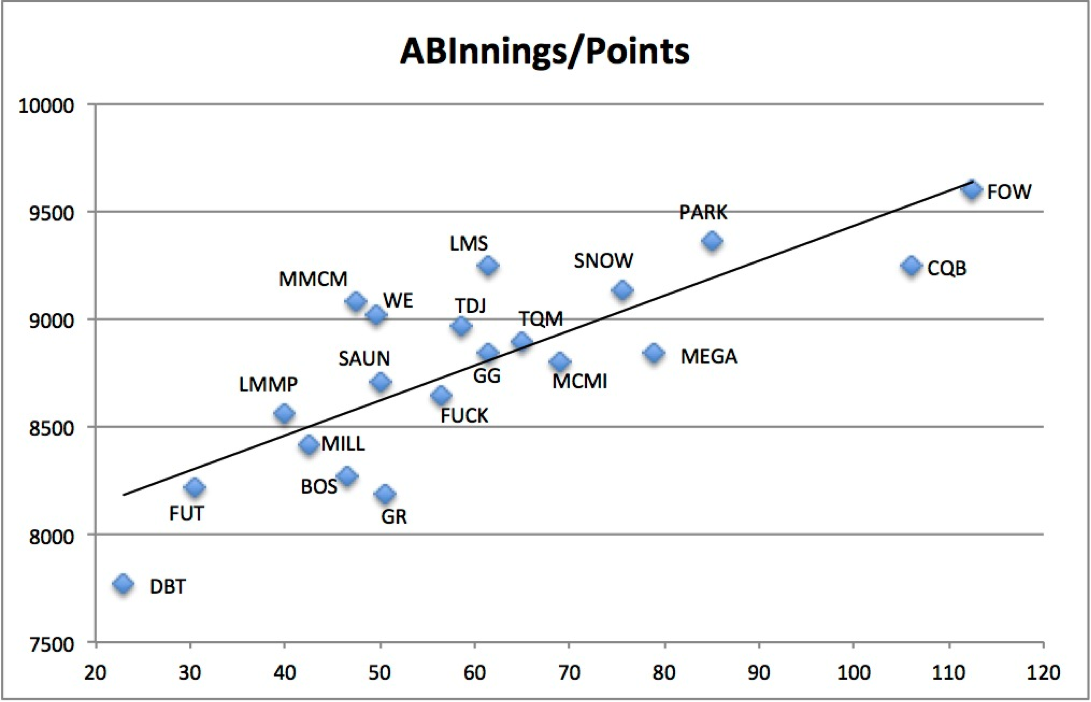
If you need some further evidence on the correlation between number of AB and IP to total points gained over the course of the season, I’ve put this chart together. Here, I combined the total AB and IP to create an ABInnings stat and plotted it against the final points standing in the table. As you can see, there’s a fairly strong link between the two. CQB is a bit of an outlier but that’s mostly because the total points available in SOP was higher and more ABInnings were recorded on average over Mayberry. Otherwise it makes for a fairly nice correlation.

SW4

So why did I go through all this effort? Basically to prove that while I may not have come 1st in the league, I had the most efficient team in both leagues and the better talent overall. I had less runs in fewer at bats, but as a percentage, this was higher than the likes of FOW and PARK. My team was gaining more runs/HRs/RBIs/SB per at bat, and more Ks, Ws and SVs per inning pitched. The only reason I lost was because they just abused the lack of limits on innings and at bats to sneak in more.

Instead I calculated the number of at bats and innings it took to earn each counting stat and from there, assigned rankings 1-10 based on who was more efficient. So for example, it took me 25.7 at bats to earn 1 HR. It took FOW 26.7 at bats to earn 1 HR, so my lower number means I was the more efficient and thus had better talent on my roster. From these line charts, you can see that not a huge amount has changed but in both leagues it would have shifted some position finishes. Most importantly though, I would have won both leagues if I’d supplemented my daily lineups with some scraps in the free agency pool.

I’m MEGA in Mayberry:

SW5

And CQB in SOP:

SW6

Hopefully we’ve learned some things for next season but I think there must be a broader tactic underlying both PARK and FOW strategy. I’m yet to totally figure it out but I imagine it has something to do with the way they stagger their pitching and batting throughout the year. Contrary to my tactic this year, it might make sense to rush through your 200 pitching starts as quickly as possible and replace as many as possible with relievers, while using your bench and any additional slots to stack batters every day for the second half of the season. Might explain how PARK came out of nowhere over the last few months to overtake me for 1st. Strange thing is though that neither FOW or PARK reached their game start limits with a lot of time to spare. So I’ve essentially hit a wall when it comes to figuring out the best way to take advantage of this tactic.

Standard

WBAE Baseball Award Season – Year 2

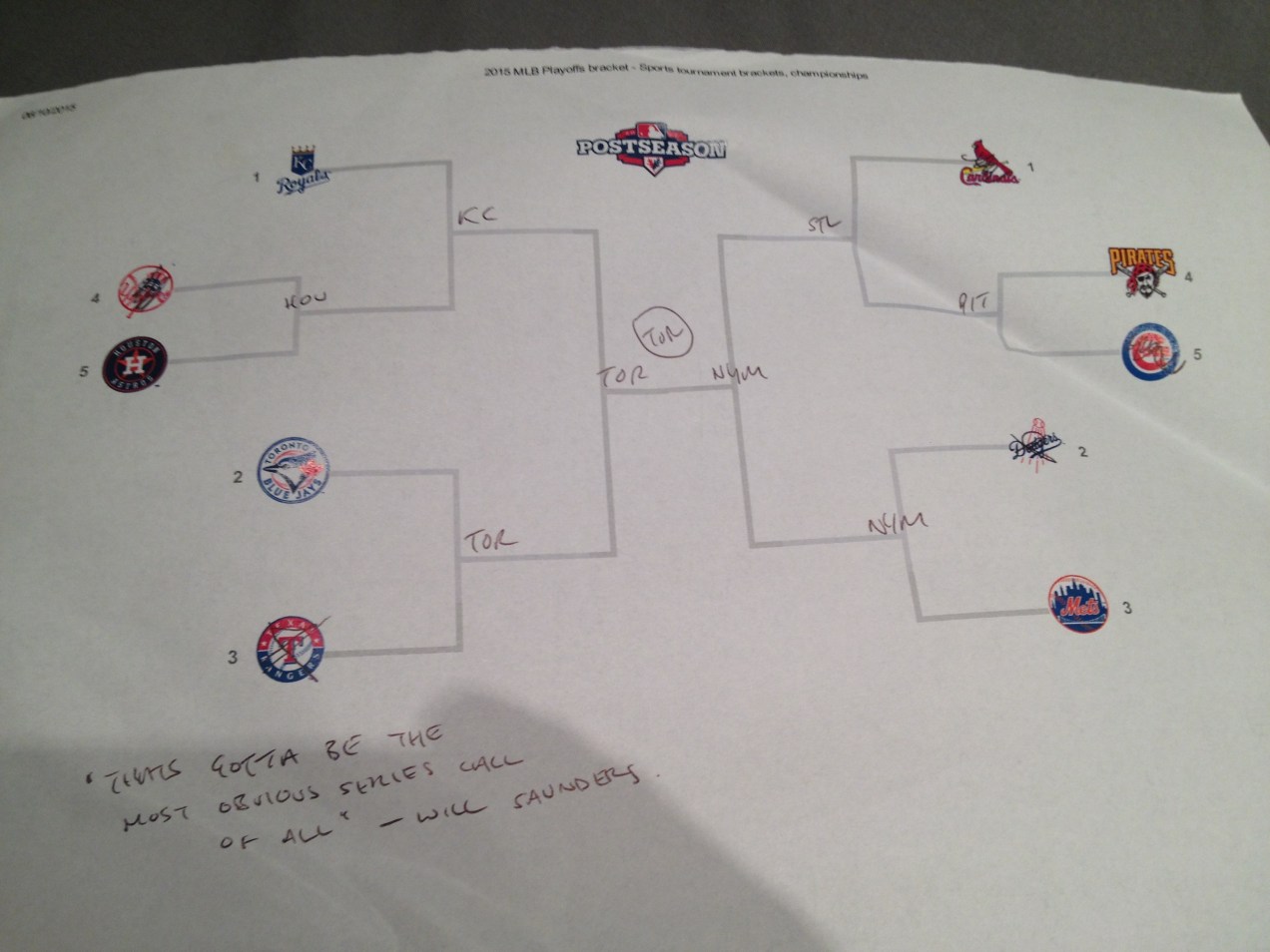
My annual end of year baseball awards dinner took place two weeks ago amid halloumi salad, sweet potato fries and some decent craft beer. However, its taken me too long to post the run-down of my picks and player awards for the year as I’ve been focused on dissecting my fantasy team. This is particularly the case as my World Series prediction is close to falling apart but there’s still a chance of it coming true – tonight could define it all. Hence why I need to post this now and write around it later, so that when it comes true I can brag about it without looking like I cheated.

Playoff prediction above, mine and Will’s player awards below.

Jake Will
MVP AL Josh Donaldson (TOR) Josh Donaldson (TOR)
MVP NL Bryce Harper (WSH) Bryce Harper (WSH)
Cy Young AL Dallas Keuchel (HOU) Dallas Keuchel (HOU)
Cy Young NL Jake Arrieta (CHC) Zach Grienke (LAD)
Rookie of the Year AL Carlos Correa (HOU) Carlos Correa (HOU)
Rookie of the Year NL Kris Bryant (CHC) Kris Bryant (CHC)
Manager of the Year AL John Gibbons (TOR) Ned Yost (KC)
Manager of the Year NL Joe Maddon (CHC) Mike Matheny (STL)


American League
Jake Will
C Russell Martin (TOR) Russell Martin (TOR)
1B Edwin Encarnacion (TOR) Chris Davis (BAL)
2B Jose Altuve (HOU) Jose Altuve (HOU)
SS Troy Tulowitzki (TOR) Carlos Correa (HOU)
3B Manny Machado (BAL) Josh Donaldson (TOR)
OF1 Mike Trout (LAA) Mike Trout (LAA)
OF2 JD Martinez (DET) Jose Bautista (TOR)
OF3 Lorenzo Cain (KC) JD Martinez (DET)
DH Nelson Cruz (BAL) Alex Rodriguez (NYY)


National League
Jake Will
C Buster Posey (SF) Buster Posey (SF)
1B Paul Goldschmidt (ARI) Paul Goldschmidt (ARI)
2B Dee Gordon (MIA) Dee Gordon (MIA)
SS Brandon Crawford (SF) Starlin Castro (CHC)
3B Nolan Arenado (COL) Nolan Arenado (COL)
OF1 Yoenis Cespedes (NYM) Yoenis Cespedes (NYM)
OF2 AJ Pollock (ARI) Starling Marte (PIT)
OF3 Bryce Harper (WSH) Bryce Harper (WSH)


Standard

162 Games Later

This year I embarked on a passion project that I’d been contemplating for some time but never had the patience to pull off. As you know, each day the point rankings get updated to reflect the latest daily point totals and who has moved up or down the table. What I’ve always wanted to do was to track those point totals throughout the season and play around with the data at the end. ESPN doesn’t allow you to go back and look at the table for June 28th 2015 (as an example), so unfortunately there’s no easy way of accessing this historical data. The only solution is to set up your own spreadsheet and manually enter the figures in every day of the season for 162 days.

Well, you’ll be pleased to know that I actually carried out this painstaking task for some unknown reason – just so I could write this blog post at the end of the season! I should point out quickly that I missed a few days by accident (approx 7 days) along the way, but these are interspersed throughout the year and don’t impact the overall trend. In this situation, I merely calculated the average for the two days either side to fill in the blanks. Forgive me my occasional holidays away from the internet, hangovers or excessive real work demands as the year went on.

Anyway, there’s little in terms of actual analysis you can really perform on the data, it’s more to create some nice charts that show how the year played out. So enjoy!

Points Tracking

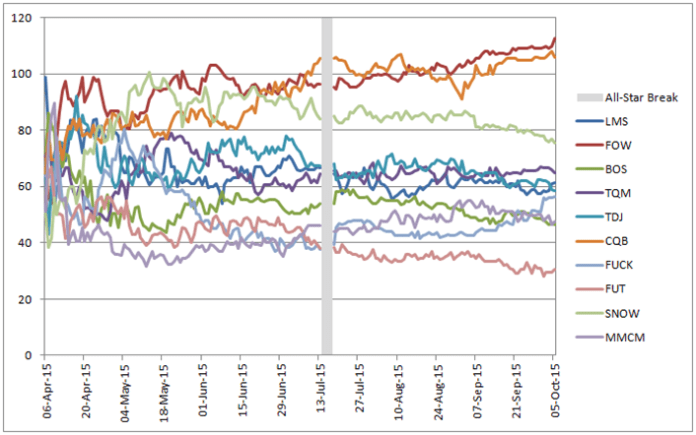
As you can see from this chart, the first team to occupy 1st place in our standings was Last Man Stanton. Those early days see lots of volatility as a big day can propel you from 10th to 1st. As early as mid-May, the top 3 teams had begun to separate themselves, and managed to hold that advantage all the way to the end of the year. Were these teams better managed? Suffer less injuries? Had better players to start with? Perhaps a combination? It’s not entirely clear but it could be the case in our league that the larger benches make it easier to horde players throughout the season and there are fewer ‘gems’ to be found in free agency on a daily basis. Perhaps places greater emphasis on drafting a good team to start with (as well as having superior Keepers). I wouldn’t entirely discount dumb luck though, as that always helps!
image1

SWFlorida Snowbirds fell away from the top two just after the All-Star Break and began a slow and steady decline. Still, a great performance from one of the newcomers this year! The battle at the top between myself and I Hate Drew Storen raged on until the last day though I was unable to really challenge him in August/September.

The really exciting battle looked to be between 4th, 5th and 6th place (Tequila Mockingbirds, Last Man Stanton and Out Of Options). Tequila Mockingbirds secured 4th in the end even though Out Of Options had generally held it down for the longer amount of time over the course of the year. Out of Options even dropped down to 6th right at the finish line by Last Man Stanton following a late surge.

There was a slightly similar dogfight among the 7th-9th place teams, which really intensified in September. Huge September surge from Joe Buck Yourself…he plays for October. Burnham Beeches managed to drag himself from last place in the first half of the year to finish in a more respectable position. Boston Navigators was one of the steadiest performers throughout the year, perhaps some high risk/high reward strategy is needed next year? Speaking of high risk strategies, it didn’t pay off for Future Proofers this year, however, with a nucleus of Kris Bryant (Rookie of the Year), Joc Pederson, Starling Marte and Lorenzo Cain, he’s found a couple of high upside picks that could form a formidable team in the future.

As we can see from the graph though, I Hate Drew Storen was certainly a worthy Champion, with prolonged stints at the top and didn’t drop below 2nd place after May!

Variance

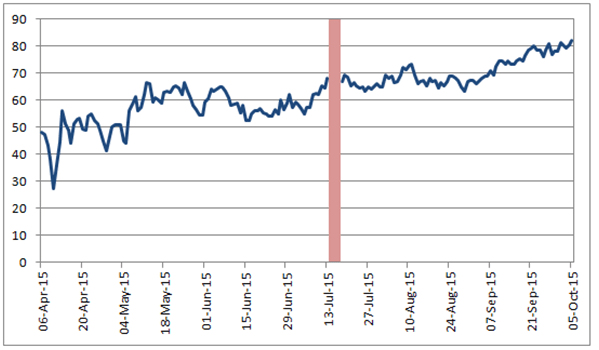
Variance is a calculation of the points spread between the highest scoring team and the lowest scoring team on any given day. Interesting to note the trend here, that the gap between 1st place and 10th place kept widening as the season went on. Obviously the gap is smaller at the beginning when we all start on the same number of points but from August to October the gap grew rapidly. I thought there might be a chance that the variance would tighten up at the end of the year as players were rested and playoff positions secured but this didn’t play out.

image2

Volatility

The trend towards greater variance between 1st and 10th as the season progresses is also evident in the volatility of point movement up and down the table. Here, I calculated the difference between the largest daily movement and the smallest daily movement to denote the level of volatility. As you can see, it really slows down as the season goes along. This makes sense, teams manage to stretch out their leads in various categories, widening the gap and making it difficult to overtake other teams. I Hate Drew Storen had a lead of over 100 Runs over me, and so was easily going to hang on to the 10 points in that category. The relationship between Volatility and Variance over the year is quite apparent therefore.

image3

Point Averages

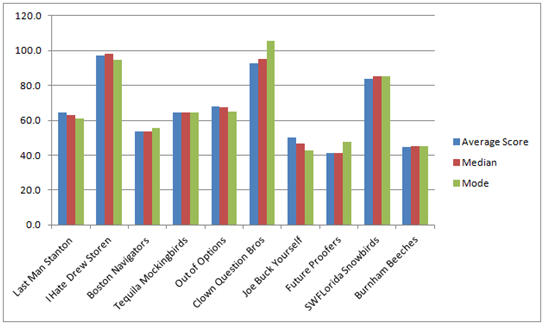
I also looked into various averages for the year, beyond the most widely used. My Mode score of 105.5 was the highest in the league, so I’ll count that as a minor victory in order to console myself from coming in 2nd. Mostly though, you can see some of the points trends I mentioned in my initial write-up on the chart below. For example, on average, Out Of Options was arguably more deserving of 4th place than Tequila Mockingbirds, even though the end of year standings say something different!

image4

Position Data

The data for who occupied which position makes for less attractive charts than pure points, so I’ve compiled it into a table. As you can see from my average position of 2.2, my median position of 2nd and my mode position of 2nd – it seems clear I fully deserved my 2nd place (and not 1st).

There’s also some fun calculations in there such as how many days each team spent in first and last. Tequila Mockingbirds and Future Proofers unfortunately never had the honour of occupying 1st place during the season. Outside of the top 3 finishers, Burnham Beeches was the only team to hold 1st place for more than one day.

Average Position Median Position Mode Position Best Position Worst Position Days Spent In 1st Days Spent In 10th
Last Man Stanton 5.4 6 6 1 10 1 1
I Hate Drew Storen 1.5 1 1 1 9 110 0
Boston Navigators 7.2 7 7 1 9 1 0
Tequila Mockingbirds 5.2 5 4 3 9 0 0
Out of Options 4.5 4 4 1 9 1 0
Clown Question Bros 2.2 2 2 1 6 47 0
Joe Buck Yourself 7.9 9 9 1 10 1 15
Future Proofers 9.1 9 10 5 10 0 83
SWFLorida Snowbirds 3.0 3 3 1 10 18 2
Burnham Beeches 8.7 9 10 1 10 2 72

The highest points score recorded this season was 112.5 by I Hate Drew Storen, actually recorded on the last day of the season. The lowest was Future Proofer’s 28 points from October 1st. The mode for the year was 65. Phew, that’s a lot of work!

image5

Standard

Is This Just Fantasy?

Fantasy baseball season is here and so ends the next 5 months of my life.

Each year following my two drafts – Mayberry (a yearly re-draft league) and Sons of Pitches (a keeper league in its second year) – I use ESPN projections to calculate how each league will theoretically play out in what has become my favourite task of the season. Its highly imperfect because it becomes out of date before the season even starts when players get picked up and dropped. Also, injuries and slumps take their toll and the projections are never super accurate. However, it does give an instant perspective on what categories each team is strong/weak on and an overall pecking order of who is expected to be the better performing teams over the course of the season.

I thought I’d pull up the draft results of 2014 and compare it with how things shook out in the league throughout the rest of that season. The long in the short of it, is that the drafting projection place finishes proved fairly accurate in Sons of Pitches and less accurate in Mayberry. For example, using the draft projections from SoP, three of the top four were forecast to finish: me (1), Burnham Beeches (3), Tequila Mockingbirds (4) – and ended the year with me (1), Burnham Beeches (2), Tequila Mockingbirds (3). Mayberry was a lot more scattered, with the likes of NC Sting Ray projected to finish 8th then coming tied for 1st.

That being said, looking at the charts below, the point projections for Mayberry seem to tally up slightly better than SoP, with less of a difference between the bars:

Mayberry 2014 – Fairly close between Projected & Actual

Inline image 1

SoP 2014 – Wider Discrepancies
Inline image 2

This actually rings true when you calculate the variance for both leagues projections vs actual:
Mayberry = -3
SoP = -8
And also the standard deviation between each individual difference compared to the average difference:
Mayberry SD = 15.3
SoP SD = 21.4
Anyway, what do these projections tell us, if anything?
1.  Moves don’t matter? The argument should be that, the more transactions made during the course of the season, the further apart the Draft Projection vs Actual score should be. Interestingly though, the number of transactions over the course of the season bore little relationship to the overall projected points. In Mayberry there were 1,317 add/drops/trades, whereas in SoP, there were 849. So we’re talking about an average of 132 moves per person in Mayberry vs 85 in SoP. Strange therefore that Mayberry should be closer to projections than SoP. Why would this be the case? Maybe waiver transactions are generally lower impact than drafts -> most of the guys you pick up or drop tend to be drafted in the later rounds and wont have the same impact as a Mike Trout or Clayton Kershaw…? Best explanation I can come up with.
2. Inactive managers skew the results a lot. Especially looking at SoP, where Team Joe Wahl and London Towners grossly underperform their projected score as their owners gave up/stopped playing throughout the year. The zero sum nature of the scoring system means that the discrepancies are exacerbated once people give up, because there are more points to go around to other league managers.
3. Fantasy talent/knowledge rises to the top. Managers in SoP were able to take strong drafts and maintain top finishes throughout the year. In Mayberry, I think the talent was more evenly distributed and you can’t keep a guy like NC Sting Ray down. He outperformed his projections by 22.5 points,
So what have we learned….probably not a lot. Conclusion is: Be really good at fantasy baseball and try not to have inactive managers in your league.
Perhaps a better study would be individual categories for the draft and actual results.
Sons of Pitches Projected Place Actual Place Mayberry Projected Place Actual Place
Clown Question Bros 1 1 Chudley Cannons 1 3
Team Joe Wahl 2 8 Clown Question Bros 2 5=
Burnham Beeches 3 2 Timonium Centipedes 3 7
Tequilla Mockingbirds 4 3 Blind Your Ponies 4 8
Boston Navigators 5= 9 Jacksonville NC Hot Shots 5 10
London Towners 5= 10 Windsor Castles 6 1=
I Hate Zack Greinke 7 6 Kentucky Beerbellies 7 5=
Joe Buck Yourself 8 7 NC Sting Ray 8 1=
Out of Options 9 4 OBX Barnacles 9 4
Last Man Stanton 10 5 Pikesville Rhinos 9 9
For this year, the projected Mayberry league is expected to be:

SCORE

PARK 61
MCMILLAN 58
GRANT 67
SAUN 61
LMMP 62
BARNEY 17
KENTUCKY 62
ELEPHANT 54
MILLER 51
CHIEF 55

Initial thoughts – Barney’s Tigers Blue Tiger had one of the worst drafts I’ve ever seen. This became clear as the draft was playing out (Cabrera at #2 overall, Kimbrel in the 2nd round, etc) but only becomes more obvious when you tally up his projected score to…17! Christ.

Another successful draft for me – I swear I don’t play with the numbers or anything. I think this was largely down to my focus on Batting – as I have 3 batters on my bench, more than anyone else, which gave me good scores for Runs, HRs and RBIs.

I’m going to be scrounging the waiver wire for Saves. Don’t know where all the closers went during the draft but have to hope for some serious churn in depth charts to snag saves. I’m also in dire need of Ks and Ws since most of my pitching staff is injured to start the year, which is far from ideal. Not enough research by me, rookie mistake.

Sons of Pitches is more difficult to project as the bench in our keeper league has been expanded to 6 spots and this kind of throws off the projections with prospects maybe not even getting to play this year. So I have decided not to redo the task for this league. Also, I’m about to repeat as Champion so who needs projections anyway?

Standard

Perfect Playoffs Prediction Post

In one of my first posts on this blog, I made the pre-season projection for the Seattle Seahawks to win the SuperBowl again. Living with that prediction through the season has been difficult as the week-to-week knee-jerk reactions during the season obscure one’s logical process. The sky was falling in Seattle by about week 6, and yet they still ended up with the number 1 seed in the NFC. After 17 weeks of the regular season, I’m glad that I didn’t write a weekly column and therefore have the opportunity to go back on my prediction multiple times.

Wild Card Round

AFC

(6) Baltimore Ravens @ (3) Pittsburgh Steelers – Steelers to beat the Ravens. Losing Le’Veon Bell (the best RB in football right now) is big, but the Steelers receiving corps is good enough to take advantage of the Ravens lack of Defensive Backs. Also, I’m going to go on record and say that Joe Flacco never wins another Superbowl.

(5) Cincinnati Bengals @ (4) Indianapolis Colts – Colts please. Dalton on the road, big game, without AJ Green, no thanks. Saying that, I can see the Bengals just running the ball 90% of the time against a weak Colts run D. Still I’m sure Dalton will find a way to lose it.

NFC

(6) Detroit Lions @ (3) Dallas Cowboys – Lions upset Cowboys on the road. Its easy to pick against a team I hate, but feel the Lions could do a job here. Their D-Line is a match for the O-Line and I’m expecting Murray has already been run into the ground this year, making it more difficult for the Offence to get going. Then it comes down to Megatron over Dez.

(5) Arizona Cardinals @ (4) Carolina Panthers – Hard to pick a completely rubbish QB in a road playoff game but I trust the Arizona coaching staff to find a way to win this one. Carolina has shown little to impress over the course of the season. Bowles and Arians are 50 times the coaching staff that Ron Rivera is.

Divisional Round

AFC

(3) Pittsburgh Steelers @ (2) Denver Broncos – Think Manning might be done. At least this year. In his last 5 games he’s thrown 5 TDs against 6 INTs. Averaging 1 TD per game is just not something Manning does. Roethlisberger and the Steelers won’t be intimidated coming into Denver, nor playing in the cold. Steelers take this one.

(4) Indianapolis Colts @ (1) New England Patriots – Patriots know the formula for beating the Colts, they’ve thrashed them 85-42 over the last two meetings. No chance of an upset here.

NFC

(5) Arizona Cardinals @ (2) Green Bay Packers – Aaron Rodgers at home:

Pct Yds Avg TD Int  Rating
Record: 8-0 68.9 291.8 9.9 25 0 130.6

Versus Aaron Rodgers on the road:

Pct Yds Avg TD Int Rating
Record: 4-4 65.0 255.9 7.4 13 5 95.9

Essentially he’s lights out at home and pretty good on the road. If they had the #1 seed, I’d back them all the way to SuperBowl. He’ll beat the Cardinals but fall to the Seahawks. Getting ahead of myself though.

(6) Detroit Lions @ (1) Seattle Seahawks – Should be a good defensive matchup, and you could argue that Detroit have a slight advantage in both Offence and Defence. Can’t go against Seattle at home though with all their guys healthy.

AFC Championship

(3) Pittsburgh Steelers @ (1) New England Patriots – Patriots Defence show their mettle, Revis on Brown, Wilfork beasting on Bell. Brady can take advantage of a fairly old and depleted LB-core and secondary. Otherwise known as, throw it to Gronkowski over and over again.

NFC Championship

(2) Green Bay Packers @ (1) Seattle Seahawks – See earlier Aaron Rodgers Home vs Away stats. Seattle dominated GB in the Week 1 opener and I don’t see much having changed since then.

SUPERBOWL

(1) New England Patriots @ (1) Seattle Seahawks –  I don’t really much like picking two #1 seeds to make it to the Superbowl but I think the two teams have been a cut above the rest this year. NE and Seattle have very few weaknesses and are basically strong across the board. Seattle have proved in the past they can handle NE and I actually think their greater challenges will come from Detroit and Green Bay. There’s a good chance that Gronk gets his knee blown up in the 1st quarter by Kam Chancellor, which will pretty much destroy the NE Offence. Brady won’t be able to move the ball with Edelman, Amendola and Lafell against Sherman and Maxwell and therefore, Brady falls to 3-3 in Superbowl appearances. U mad bro?

And now for a long-held tradition (at least for the last year since before this blog existed), my girlfriend will make her picks for the playoffs. She is American so in theory is imbued with greater knowledge than me although she doesn’t watch any NFL and pretty much hates it. Now watch her pick the aforementioned perfect playoff bracket.

Round 1: Ravens over Steelers. Indy over Cincy. Detroit over Dallas (this pick was made entirely on the basis of not making me angry). Cards over Panthers.

Round 2: Patriots over Ravens. Broncos over Indy. Detroit over Seattle. GB over Cards.

Round 3: Patriots over Broncos. GB over Detriot.

Superbowl: Patriots over the Packers.

A fairly feasible scenario all in all considering it took her less than 1 minute. Brady winning it all…clearly she has a thing for handsome men.

Standard

WBAE Pro Bowl Awards

The end of the NFL season draws nigh and after a truly crushing week 16, I feel like I’m ready to face the sport again.

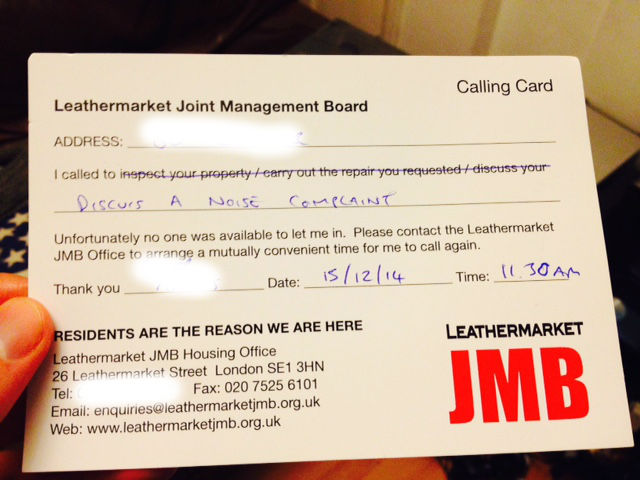
The 9-3 Eagles went rapidly to 9-6 after a blow out by the Seahawks, a near blowout by the Cowboys and one of the worst performances I’ve ever seen against Washington. The loss to the Cowboys was so bad that one of my neighbours complained to the Council after my shouting, banging the table and punching the sofa was deemed to be excessive. My excuse was to blame some combination of Cary Williams, Bradley Fletcher and Bill Davis for constantly leaving Dez Bryant open but apparently that wasn’t a sufficient justification for Leathermarket JMB.

While the game theoretically ended the Eagles season, we were still technically alive against Washington the following week, until that was over in excruciating fashion. Then my 11-3 fantasy team lost in the Championship after its lowest output of the year, thanks to AJ Green. I feel its worth noting some of these incidents, as it may colour my upcoming selections.

Everyone knows the Pro Bowl is a joke, the fans, the players and the coaches would tell you the same. Even the NFL knows it sucks and tries every year to shake things up to make it better. In particular, the large number of selected players makes it a joke. However, the list of All-Pro candidates is perhaps too small, so I’ve devised a system of picking a starting 11 from each conference, to try to combine the best of both worlds. We’ll see how this shakes out as I make my selections for the year. I’ll also be up-front and forewarn you that my Offensive Line knowledge is pretty limited as far as things go.

NFC AFC
QB Aaron Rodgers (GB) QB Tom Brady (NE)
RB DeMarco Murray (Dal) RB Le’Veon Bell (Pit)
RB Matt Forte (Chi) RB Arian Foster (Hou)
WR Jordy Nelson (GB) WR Antonio Brown (Pit)
WR Dez Bryant (Phi) WR Demaryius Thomas (Den)
TE Greg Olsen (Car) TE Rob Gronkowski (NE)
OL Jason Peters (Phi) OL Joe Thomas (Cle)
OG Zach Martin (Dal) OG Marshal Yanda (Bal)
C Travis Frederick (Dal) C Alex Mack (Cle)
OG Jahri Evans (NO) OG Joel Bitonio (Cle)
OL Tyron Smith (Dal) OL Andrew Whitworth (Cin)

Following the O-line caveat, I literally just went off the lists of pre-selected names for the Pro Bowl as well as some expert picks, combined with any few things that I saw this year. For example, Andrew Whitworth has been great for a few years so he gets my vote. Fairly impossible to argue against selecting most of the Dallas line as much as it pains me to do so. Also, my pick of Alex Mack is pretty ridiculous too, since he’s been out with a season-ending injury since week 7 meaning he played less than half of a season. Mostly this pick is due to the fact I very much dislike the Pouncey brothers and refuse to select either of them given their personal history of being complete and utter morons. I went with Mack because its clear how much the Browns missed him in the run game after he got injured, so in my mind was even more valuable to his team. #Analysis.

Other potentially controversial selections based on actual Pro Bowl votes and other overall consensus include Matt Forte over Marshawn Lynch and Lesean McCoy (to a lesser extent) because he set a new record in receptions by a RB while figuratively and literally carrying the Bears offense for most of the year. Greg Olsen over Jimmy Graham because the latter sucked for the last quarter of the season and did very little to get his team into the playoffs. Picking the AFC QB was also difficult considering the options between Brady, Peyton Manning, Ben Roethlisberger and Andrew Luck. Ultimately I felt it came down to Roethlisberger and Brady and I gave the advantage to Tommy as he was working with less and ended up with the no.1 seed in the division. Ben also padded his stats against a few weak opponents that made his numbers look better.

Unfortunately, I was forced to take Jeremy Maclin off the list in favour of Dez Bryant. Dez destroyed the Eagles and set new records in TD receptions for the Cowboys. This makes me feel dirty, let’s move on.

NFC AFC
DL Fletcher Cox (Phi) DL JJ Watt (Hou)
DL Michael Bennett (Sea) DL Mario Williams (Buf)
DL Gerald McCoy (TB) DL Marcell Dareus (Buf)
DL Calais Campbell (Ari) DL Muhammed Wilkerson (NYJ)
LB DeAndre Levy (Det) LB Justin Houston (KC)
LB Connor Barwin (Phi) LB Elvis Dumervil (Bal)
LB Bobby Wagner (Sea) LB CJ Mosley (Bal)
DB Richard Sherman (Sea) DB Vontae Davis (Ind)
DB Harrison Smith (Min) DB Darrelle Revis (NE)
DB Antoine Bethea (SF) DB Chris Harris (Den)
DB Glover Quin (Det) DB Tashaun Gipson (Cle)

Ahh, much better, the defensive side of the ball where no Dallas player comes close to getting on the list. Set the teams up in a 4-3 defence as they are the most common and generic. In the end, I had to sub out specific CB and S positions into a more generic Defensive Back (DB) allocation, in order to squeeze in a few additional players. The biggest oversight here is the lack of Earl Thomas in the NFC team. He’s 100% the best Safety in the league but I thought it best to give some props to the next tier of guys, who really stepped up this year. In particular, Antoine Bethea was ridiculous this year, he was all over the field making plays and I watched him straight dominate some teams.

The rest of the Seattle D is just a joy to watch unless its your team up against them. It feels like its impossible to move the ball consistently or get big plays against them. Every throw is a check-down, short of the line of scrimmage and the receiver instantly gets blown up. Super scary. Bobby Wagner missed a few games this year, but again, his absence was noticeable in the way Seattle played over that stretch. He went off injured in the 2nd quarter of the Dallas game and came back noticeably slower. Seattle went on to lose that game, while Wagner sat for another 5 games, with the team losing another 2 of that stretch, starting the season at just 6-4. Since he game back, they won the next 6, locked up the #1 seed and made the talk about Seattle not looking right during that rough stretch (Russell Wilson not ‘black enough‘) seem like a distant memory.

Definitely had to give some recognition to Fletcher Cox and Connor Barwin from the Eagles. Cox has been making plays all year, encouraging to see after the Eagles switched from his natural 4-3 to a 3-4 defence two years ago. That has benefitted Barwin a lot, who now had the lanes to get after the QB, as well as batting balls and covering TEs. Led the NFC in sacks. Cheers.

Other notes: JJ Watt = MVP, credit Jim Schwartz for turning the Buffalo D-line into one of the most feared units in football, Vontae Davis putting his physical attributes together to become one of the best CBs in the league, Chris Harris super underrated, CJ Mosley = the most typical Ravens draft pick of all time.

Playoffs are upon us now but for many teams, the countdown to the next meaningful game begins: September 13 2015.

Sigh only 36 weeks and 3 days to go.

Standard

Are The Sixers Tanking Too Hard?

In my time as a 76ers fan, I remember two distinct moments of unbridled hope and joy as a result of their on-the-court exploits. The first was June 7 2001, the morning after Game 1 of the 2001 NBA Finals. I was visiting Philadelphia with my family and flew back to London on June 6, the day the 76ers beat the Lakers. I didn’t actually get to watch the game because I was on the plane. However, moments after we touched down on UK soil, the pilot announced to the cabin that the 76ers had emerged victorious from Game 1. Most of the plane cheered, clapped and celebrated and I joined in too, without realising that this would be the closest to an NBA championship the 76ers would get over the next 15 years.

The second was May 11 2012, again, the day after a Philadelphia win. I sat in my house and watched Andre Iguodala hit two free throws with 2.2 seconds remaining against Chicago to clinch the series in the 1st round of the playoffs by 79-78. An 8 seed, undeservedly knocking off the 1 seed because Derrick Rose went down with what would be the start of 2 years worth of injuries. I knew we had no right advancing to the second round but I enjoyed it anyway.

In the grand scheme of sports, these are fairly low-key achievements. The 1-0 start in the 2001 Finals is clearly the most impressive of the two but I didn’t even get to watch that game. The Sixers haven’t been relevant in the NBA since Allen Iverson. Their 2012 playoff victory was a mirage and brought on the disastrous Andrew Bynum trade, in which we swung for the fences and got burned badly. The trade was horrendous as Bynum never played a minute for the Sixers but the thought process behind the trade was sound. Had he stayed healthy there was a chance he could make the team a legit title contender. Unfortunately, it wasn’t to be and I’ve been on board with tanking ever since Bynum decided to destroy his knee and career going bowling when he should have been recovering.

Any defence of tanking does not start with the Bynum trade. It starts with the end of the Iverson era and the mediocrity the team has endured since. Between 2006-2013, the Sixers averaged a position finish of 8.4 in the Eastern Conference, the definition of average/mediocre/irrelevant. It also bowed out of the playoffs in the 1st round in 3 seasons and progressed to the 2nd round once, in the aforementioned 2012 season. Anyone who knows how the NBA is structured will tell you that 8th place finishes and 1st round exits are the worst place for a franchise to be, as the chances of a NBA championship are virtually non-existent, while simultaneously taking you out of the lottery and reducing your chance of a high impact draft pick.

The only solution is that you draft well for your position and hope to hit on the rare late-round guy who turns into a superstar. Again, the problem here was that the Sixers drafted well but not well enough, but also not bad enough. Here is a list of the 76ers picks since the Iverson draft, with years played in the league as well as the players they could have gotten with the benefit of hindsight (bearing in mind their draft slot).

Year Round Pick Drafted Years In League Achievements  All-Stars/Notable Players Missed
2013 1 11 Michael Carter-Williams 2* NBA All-Rookie First Team (2014), NBA All-Rookie First Team (2014)
2013 2 35 Glen Rice, Jr. 1*
2013 2 42 Pierre Jackson
2012 1 15 Maurice Harkless 3* None
2012 2 45 Justin Hamilton 1
2012 2 54 Tornike Shengelia 2
2011 1 16 Nikola Vučević 4* None (Kenneth Faried, Chandler Parsons)
2011 2 50 Lavoy Allen 4*
2010 1 2 Evan Turner 5* DeMarcus Cousins, Paul George
2009 1 17 Jrue Holiday 6* NBA All-Star (2013) None
2008 1 16 Marreese Speights 7* Roy Hibbert, Goran Dragic
2007 1 12 Thaddeus Young 8* NBA All-Rookie Second Team (2008) Marc Gasol
2007 1 21 Daequan Cook 6
2007 1 30 Petteri Koponen 0
2007 2 38 Kyrylo Fesenko 5
2006 1 13 Thabo Sefolosha 9* Rajon Rondo, Paul Millsap
2005 2 45 Louis Williams 9*
2004 1 9 Andre Iguodala 10* NBA All-Star (2012), NBA All-Defensive First Team (2014), NBA All-Defensive Second Team (2011), NBA All-Rookie First Team (2005), Olympics Al Jefferson, Jameer Nelson
2003 2 50 Paccelis Morlende 0
2002 1 16 Jiří Welsch 5 Carlos Boozer
2002 2 44 Sam Clancy, Jr. 0
2001 1 26 Samuel Dalembert 15* Tony Parker, Gilbert Arenas
2001 2 36 Damone Brown 3
2001 2 56 Alvin Jones 1
2000 1 20 Speedy Claxton 7 Michael Redd
2000 2 48 Mark Karcher 0
1999 2 47 Todd MacCulloch 4
1998 1 8 Larry Hughes 17 NBA All-Defensive First Team (2005) Dirk Nowitzki, Paul Pierce
1998 2 37 Casey Shaw 1
1997 1 2 Keith Van Horn 11 NBA All Rookie First Team 1998 Chauncey Billups, Tracey McGrady
1997 2 33 Marko Milič 2
1997 2 35 Kebu Stewart 1
1997 2 36 James Collins 1

Note: Names in italics were traded before playing a game. * indicates player still active.

For the most part, that is a fairly solid drafting record. With most players taken becoming serviceable NBA players that played for at least 7 years in the league and/or are still active. They even got some production from their second round picks, which are far more difficult to hit on. Looking at “what they could have won” yields around 8 potential transformative picks over the 16 year sample; McGrady, Billups, Pierce, Nowitzki, Parker, Cousins, George and Rondo. Nowitzki is the big ‘miss’ but no one could have known at the time that he would go on to be a future Hall of Famer. He’s also the only one you could argue would be good enough to win a ring by himself, as clearly the best player. It  would also be near impossible to project the achievements of Parker and George given their relative obscurity and late draft slots. Probably Cousins represents the clear cut whiff, when they took Evan Turner over him in 2010 but even so, the jury is still out on whether Cousins can keep his attitude in check to match his monstrous talent.

Nevertheless, I’d argue a reasonable drafting track record but not good enough to challenge for a Championship. Even with a few All-Star selections (Jrue and Iggy), the team had no hope of ever really getting out of the 1st round. The problem is that there’s little chance of hitting on those HOFers or superstars so late in the draft. We made a run at acquiring a potential superstar in the Bynum trade and it was an unmitigated disaster. Any other potential trades are out of the question, as the Sixers surrendered an all-star in Iguodala, emerging star Vucevic, Mo Harkless and a future 1st rounder. In total, what they gave up was 4 1st round picks. There’s no coming back from that.

Again, I don’t fault the logic behind the Bynum trade. However, I do take issue with the rest of the Doug Collins era in Philadelphia. Some truly horrendous decisions include signing Kwame Brown to a 2-year deal, bringing in Nick Young, drafting Evan Turner and trading a 1st rounder (now 2 2nd round picks) to get Arnett Moultrie. The on-the-court product wasn’t much better, a slew of mid-range jump shots, Jodie Meeks at SG and stunting any possible development of Turner by keeping him on the bench and barely playing him in his first few seasons. Why even take him if he wasn’t going to make a difference? Before the arrival of GM Sam Hinkie, the situation was pretty dire, and tanking for draft picks was a logical conclusion.

It became pretty clear that was the direction of the franchise when Hinkie traded Jrue for Nerlens Noel and another 1st rounder. The basketball world knew the Sixers were tanking and compounded it further by trading off nearly everything that wasn’t bolted down at the deadline for 2nd rounders. They finished with the second worst record in front of the Milwaukee Bucks, however, it was the Sixers who drew the ire of the NBA and the other franchises.  Largely, this was due to the 26 game losing streak that tied the 2010-2011 Cleveland Cavaliers for the worst of all time. This season, they have started out 0-11, closing in on the worst ever start to a season, 0-18 by the 2009-10 New Jersey Nets. Everyone knows the management is tanking, that much is obvious. The players know it too, and that’s more distressing.

I’ve approved of all the moves they’ve made so far, even managing to get back the pick they traded to Orlando for Bynum through selecting Elfrid Payton, then trading Payton for Dario Saric and the 1st round pick. Noel and Embiid were the consensus #1 picks from the experts coming into the draft and they fell because of injury. Great! Take them. Trading players like Turner, Spencer Hawes and Thad Young and getting picks in return even though they would leave for nothing at the end of the year was also smart. MCW seems like a good draft choice. I’ve even been on board with the endless cycle of D-League players to try to find that hidden gem. The coaching choice of Brett Brown also seems to be a solid one – his background is in player development from the best-run franchise of the past 20 years (the San Antonio Spurs). If anyone can help these youngsters grow into the league, you’d hope it would be Brown.

However, there’s a few things I’m concerned about:

2012 Charlotte Bobcats 7-59 (10.6% winning percentage)

1973 Philadelphia 76ers 9-73 (11.0% winning percentage)

These two teams represent the most futile in the history of the NBA. As much as I want the Sixers to tank, I don’t want them to break either of those two records for fewer winners and a lower winning percentage. As much as they are a ‘disgrace’ to the game and ‘shaming’ the whole league, records last forever, and I don’t want the team that I support to be on that list twice. If the team doesn’t get their first win soon, it could be hard-pressed to meet that threshold.

I disagree with the ‘talking head’ folks who talk of creating a ‘culture of losing’ and that somehow the team will never learn ‘how to win’. Those concepts are meaningless and superfluous. The Seattle Sonics/OKC Thunder didn’t create a culture of losing around Kevin Durant and Russell Westbrook during their formative years. However, I think there’s something to be said for not signing players that can actually help the team now. I understand the player development angle and taking minutes away from a younger guy who could contribute down the line but these players need some experience in the locker room and on the court to play better down the line. Hinkie has sought a strategy that seemingly focuses on finding the most athletic guys, who are long and can defend but can’t shoot. But I don’t see any upside to surrounding your PG (MCW) with a bunch of guys who can’t shoot. The burden falls on him to create offense as he knows that he can’t pass to half of his teammates and expect them to hit shots. Passing the ball around, trying to find an open man tends not to happen and the offense frequently breaks down with a lack of ideas and imagination. The close fought game agains the Rockets was the perfect example. MCW, fresh back from a long injury layoff, turns the ball over on the second to last possession as there is a lack of spacing on the floor. Then, to win the game, Brown calls an isolation play for MCW to hit a mid-range jumpshot that he is not great at taking anyway.  If your teammates aren’t at a decent level, that creates a temptation to try to do everything yourself.

Similarly, on defense, the team has very little concept of rotations and how to properly close down open shooters. Given that the team is a “moneyball” team that believes in the value of 3 pointers, layups and taking fewer mid-range shots, their defence at stopping 3point shots is horrendous. I’m not quite well-versed in basketball-reference.com to pluck a stat from its databases to prove the point but watching them play, they give up a litany of open 3s, especially from the corner. With no veteran presence or experienced NBA player on the team who knows where to rotate to, the defence is a mess and again, they won’t learn these things by just playing 82 games over and over. Younger players need guidance to know who to close out and take their cues from an experienced player who can tell them where to go.

My final point of contention with the strategy is that it will ultimately drive players away and limit the chances that Free Agents will want to play in Philadelphia. Much of this will be mitigated by getting a star player in the Kevin Durant, Lebron James echelon who will attract players to the franchise just by playing for them. In the short-term, there is a risk that once the Front Office does try to sign lucrative Free Agents, they will come up short due to the way they’ve treated their players over the past few years. On draft night when they picked Elfrid Payton, it was clear that MCW was visibly distressed and thought he was going to be traded. Even now, I believe its highly likely the Front Office would trade him in a second if it got a reasonable offer. The fact that he wrote a submission to Derek Jeter’s new website asking that people “Don’t talk to me about tanking” shows he’s clearly unhappy in the organisation and would probably bolt the first chance he gets. Collecting all these young ‘assets’ is great but treating them as such doesn’t build any sense of attachment to the team. Just look at what happened with Chandler Parsons and the Rockets, the franchise where Hinkie learned his trade from ultimate numbers guy Daryl Morey. KJ McDaniels has also taken something of a stand by betting on himself and becoming a restricted free agent as soon as the end of this season. All this creates a bad feeling about the Sixers, potentially scaring off future contributors and leading to a revolving door of players that don’t want to stay long-term. You think Kawhi Leonard would follow the same path he is now with the Spurs, trusting that they’ll take care of him, if he was with the current Sixers team instead? Absolutely not.

The team is rebuilding and I’m patient, happy to ride it out. No one knows when this team will be close to being competitive and that doesn’t matter either. What will matter is if in 5 years time there is still no cohesion between the players because the FO didn’t do the best job they could do at trying to develop the talent they had. I just hope I’ll have a third distinct memory to add to my list before then.

Standard

Please Not Another ‘London Calling’ Title

This weekend marks the 3rd 2014 NFL International Series game held in Wembley Stadium. It also coincides with the announcement of the three games scheduled for London next year:

Buffalo Bills @ Jacksonville Jaguars

NY Jets @ Miami Dolphins

Detroit Lions @ KC Chiefs

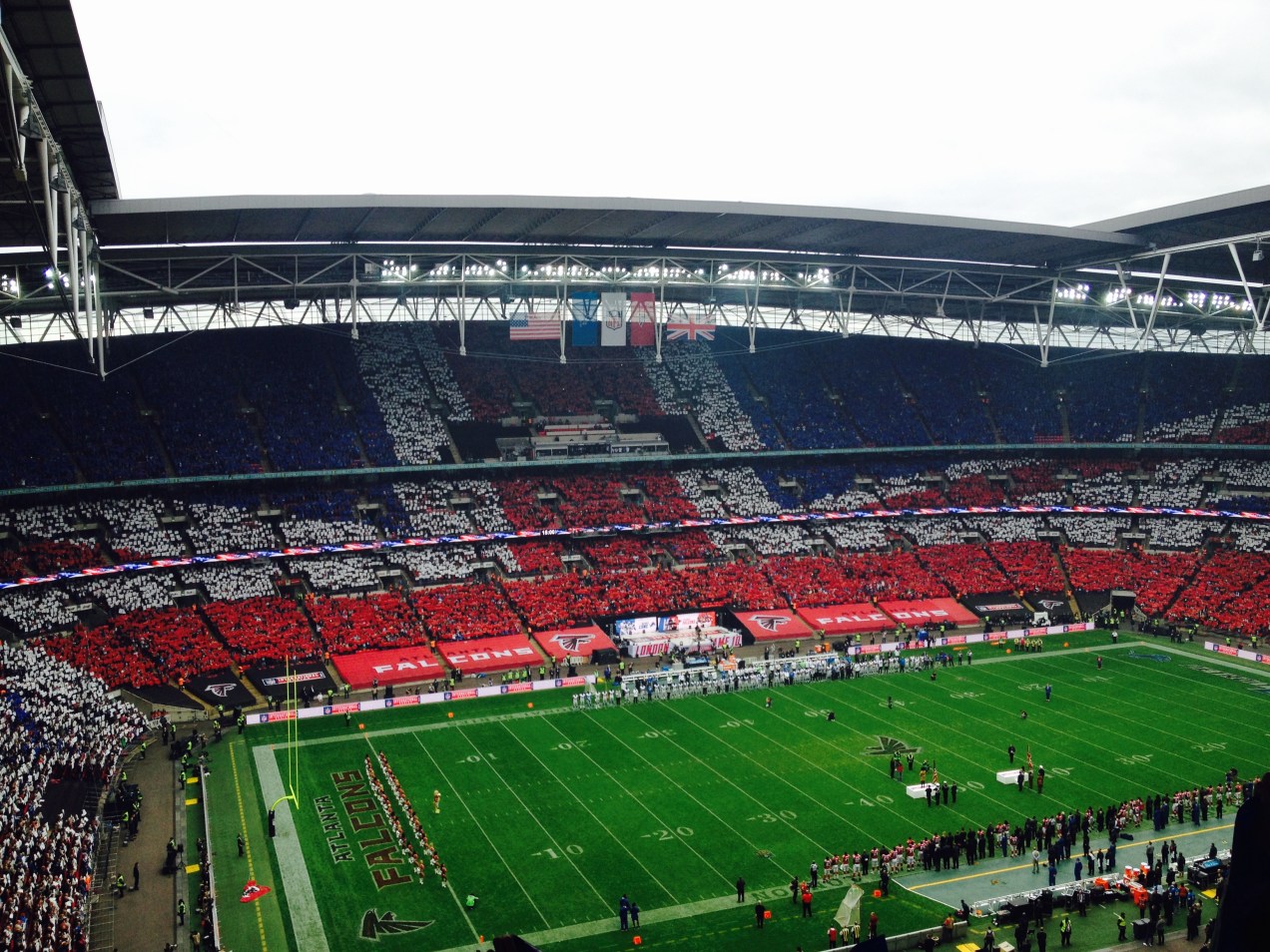
In short, an absolute garbage lineup. Perhaps I should be more grateful, I am lucky enough to live in the city that the NFL has designated for its international expansion plans and get to watch three live games a year. The NFL offers reasonably priced season tickets for the games and it is fun every time. I was also a fan of the 1pm GMT kickoff between the Lions and the Falcons. But my goodness, I do not want to watch any of those games next year, even from the comfort of my own living room, let alone paying money to watch in a stadium.

These games are in fact, so awful, I am wondering whether this is a plan by the NFL to see if they can sell out the worst matchups that they can find. With attendance averaging 82,763 at Wembley across each game dating back to 2007, this means London has the second highest attendance figures in the whole league, behind only the Dallas Cowboys. More importantly, the TV rights are lapped up and sold onto Sky Sports and the brand is advanced across the UK and Europe. Despite the fact the 2015 lineup is awful, I expect that they will sell out all three of the games. The NFL’s mission to catch on in the UK has been a success. All signs point to a franchise being the next logical step for London and with 84,000 people showing up to watch the Raiders and the Dolphins earlier this year, who can blame them?

Year Designated Visitors Designated Home Team Attendance
2007 New York Giants Miami Dolphins 81,176
2008 San Diego Chargers New Orleans Saints 83,226
2009 New England Patriots Tampa Bay Buccaneers 84,254
2010 Denver Broncos San Francisco 49ers 83,941
2011 Chicago Bears Tampa Bay Buccaneers 76,981
2012 New England Patriots St. Louis Rams 84,004
2013 Pittsburgh Steelers Minnesota Vikings 83,518
2013 San Francisco 49ers Jacksonville Jaguars 83,559
2014 Miami Dolphins Oakland Raiders 83,436
2014 Detroit Lions Atlanta Falcons 83,532
2014 Dallas Cowboys Jacksonville Jaguars
2015 New York Jets Miami Dolphins
2015 Buffalo Bills Jacksonville Jaguars
2015 Detroit Lions Kansas City Chiefs

Well, apparently, pretty much every US fan on every message board on NFL.com, ESPN.com, PFT and MMQB can blame them:

It’s called the NATIONAL Football League, not the INTERNATIONAL Football League!

This is the most commonly used line of reasoning by American fans of the sport. Its only a few steps away from “America is for Americans!” and “Ein Volk, ein Reich, ein Führer“. I’m not totally sure that English people in the 1800s were complaining about Spanish and Dutch folks playing football, although granted, they didn’t have the medium of Twitter to complain through. The spread of sports to other countries has only enriched viewing experiences and the talent pool. There’d be no Lionel Messi or Cristiano Ronaldo for one, and even in US sports, there would be no Yu Darvish, Yasiel Puig, Pau/Marc Gasol and Hakeem Olajuwon, etc. This year in the NBA, 101 players from 37 countries, a new record, will be on NBA rosters at the season’s start (2014-15). That was an increase from last year of 92 players, which at the time, was a new record. The influence of the game is spreading and having a huge impact on the dynamics of the league. That means that 22.6% of the NBA is an international player (out of 450 roster spots). That’s a huge number! Unfortunately, there’s no easy way of finding similar figures for the NFL barring a manual search through every roster. Given that there are 1,696 active players on the roster, there is no way that international players make up a figure as high as 22%. Expanding the game to other countries could sincerely help the overall development of the game.

Now, I understand that the NFL is inherently different from football, baseball, basketball and hockey, etc but these games are all different from each other and have all managed to grow abroad. I think a lot of the anger stems from the shorter season length and the fear that it will be their team that becomes relocated. Those 8 home games are so much more valuable than the 41 NBA home games or 81 MLB home games. In a playoff hunt, the difference between playing in London or playing a home game could cost you a spot in the postseason, which is generally why we don’t get the Patriots or Cowboys giving up home games to come here. It’s not necessarily fair but look at the attendance percentages for those who are giving up home games to come here:

Rank Team Average Home Attendance Percentage Rank Team Average Home Attendance Percentage
1 Dallas 89,546 111.9 17 Kansas City 75,070 97.8
2 Green Bay 78,067 107 18 Arizona 61,448 96.9
3 Minnesota 52,247 104.5 19 Pittsburgh 62,066 95.5
4 Indianapolis 65,356 103.7 20 NY Giants 78,522 95.2
5 Philadelphia 69,596 103 21 Buffalo 69,306 94.8
6 Seattle 68,410 102.1 22 NY Jets 78,160 94.7
7 Chicago 62,191 101.1 23 Jacksonville 63,443 94.5
8 Denver 76,937 101.1 24 Miami 70,510 93.8
9 Houston 71,773 101 25 Cleveland 67,421 92.1
10 Baltimore 71,127 100.2 26 Tampa Bay 59,745 91
11 New Orleans 73,051 100.1 27 San Diego 63,300 88.8
12 Tennessee 69,143 100 28 Cincinnati 57,627 88
13 New England 68,756 100 29 St. Louis 57,341 87.8
14 Carolina 73,779 100 30 Washington 78,839 86
15 Atlanta 70,578 99.1 31 Oakland 53,164 84.4
16 Detroit 63,216 98 32 San Francisco

St. Louis this year can’t sell out 90% of a stadium that is smaller than 60,000 people, which is why their owners are casting their eyes around for a bigger, more interested market. Other teams like the Falcons and Saints would never move but want to grow the brand. And why not? More revenues for the league, also means more revenues for the players.

The issues of logistics and scheduling are far more crucial to the overall success of the London franchise dream. Other writers have covered this in far more detail than I could hope to do, so I won’t touch on this too much. I still think a London team is a long way off, and will be a much more gradual thing, with 3 games ramped up to 5 over the next few years and maybe 8 after that, just to ensure they could sell them all out. Chances are, they could sell out all 8 and with the new idea of earlier starts (1pm GMT/8am EST) proving to be a success both in England and in the US, that would be a smart way of ensuring more people show up.

To be honest, I’m not fussed either way whether we get a team. In a 3-person sample conducted by WrittenByAnEnglishman (1 of which was myself), 66.6% of English fans would support their current team over a London franchise if the two were to meet in the SuperBowl. I’d go to the games and root for them but I wouldn’t support them over the Eagles. I’m stuck with Philadelphia for better or worse (mostly worse) for the rest of my life. I don’t particularly care whether we get a team but I can see that the potential benefits of doing so would be great for the league. The success of a London franchise won’t be based on whether its financially viable (it is) but whether its logistically viable (not yet). In the mean time, I’ll be booing the Cowboys at Wembley as loud as I can.

Standard